If you sell to businesses in Europe, you may have already received an email saying "From now on we only accept structured invoices." That is not a customer whim. Several governments are making machine-readable B2B invoices compulsory, in stages, and the first of them are live.
First, three words that sound alike
| Term | What it means |
|---|---|
| Receiving | Your systems can accept and process a structured invoice from a supplier. |
| Issuing | You must send structured invoices to customers. |
| Reporting | You must send tax data about the transaction to the authority. This is separate from the invoice itself. |
Mandates often start with receiving. A business may have to be ready to receive e-invoices long before it has to send them.
The calendar
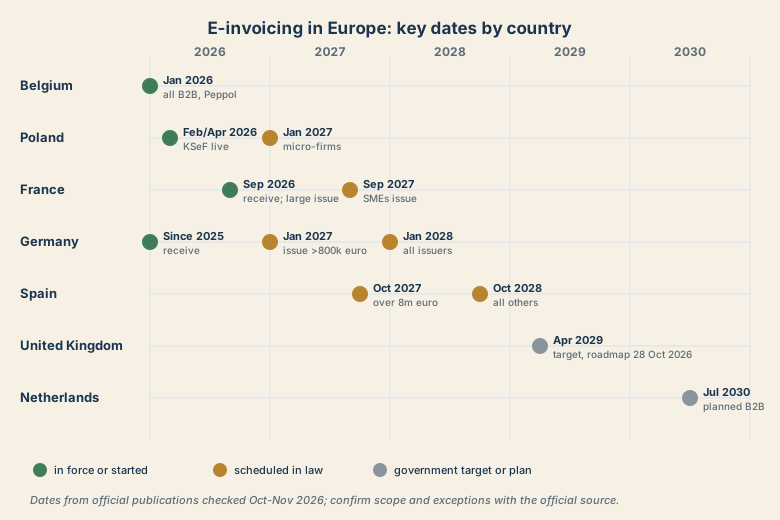
| Country | What applies | Key dates |
|---|---|---|
| Belgium | B2B structured e-invoices via Peppol for VAT-registered businesses | In force since 1 January 2026 (a tolerance period ran until 31 March 2026) |
| Poland | National platform KSeF | 1 February 2026 for the largest taxpayers, 1 April 2026 for most others, micro-businesses follow in January 2027 |
| France | Receive via an approved platform; issuance by company size | 1 September 2026: everyone receives, large and mid-sized companies issue. 1 September 2027: SMEs and micro-businesses issue |
| Germany | Receive since 1 January 2025; issue by turnover | 1 January 2027 for issuers above 800,000 euros prior-year turnover. 1 January 2028 for the rest |
| Italy | Domestic system (SdI) | Main regime since 2019 |
| Spain | Structured B2B invoices | 6 October 2027 above 8 million euros turnover, 6 October 2028 for others |
| United Kingdom | Roadmap published 28 October 2026 | Target 1 April 2029, detailed rules expected 2027–2028 |
| Netherlands | Government plan, law not yet written | Planned 1 July 2030 for B2B |
At EU level, the VAT in the Digital Age package sets 1 July 2030 for digital reporting based on e-invoicing for covered cross-border B2B transactions. That does not mean every domestic invoice must be structured in 2030; domestic rules are national.
Three formats you will meet
All of them rest on the European semantic standard EN 16931, but they look different to a developer.
- XRechnung (Germany). Pure XML, in UBL or UN/CEFACT CII syntax. Built for public-sector use and accepted between businesses.
- ZUGFeRD and Factur-X (Germany and France). A hybrid: a normal-looking PDF/A-3 with the XML embedded. Humans read the PDF, software reads the XML.
- Peppol BIS Billing 3.0 (Belgium and many others). UBL XML delivered over the Peppol network, a "four-corner" model in which each side connects through an access point.
Delivery rules differ. Germany has no mandatory network, so a compliant invoice can arrive by email. France requires an approved platform. Belgium defaults to Peppol. Italy uses its central exchange system.
How to tell whether a rule applies to you
- Which legal entity invoices, and where is it established? VAT registration may not equal establishment.
- Is the transaction domestic B2B? Consumer sales and many cross-border sales are handled differently.
- Which stage applies? Check the turnover test for that country and year. Germany's 800,000 euro line and Spain's 8 million euro line are different tests, and the figure refers to the issuer.
- Does a small-business exemption help? Germany's small-business scheme exempts sending but not receiving. Belgium's small-business VAT exemption does not by itself remove the duty.
- Which channel? A correct XML file can still fail if it does not travel through the required route.
For a developer: a minimal plan
- Model the data once. Store invoice data in a structure that maps to EN 16931 fields (seller, buyer, tax lines, payment terms, references), then render to each syntax.
- Validate before you send. Use official validators such as the German KoSIT validator for XRechnung or the Peppol validation artefacts. Open-source libraries such as Mustang can read and write ZUGFeRD and Factur-X.
- Keep the original. Store the exact XML you sent or received, not only a PDF rendering.
- Separate invoicing from reporting. Poland, France, and Spain add status or reporting steps with their own interfaces.
- Plan for Peppol. An access-point provider is the least work for cross-border invoicing. Japan's Digital Agency also built its national e-invoice specification, JP PINT, on Peppol, so Japanese and European systems share common ground.
If you are a small business outside these countries
You may never fall under a national mandate, but your customers do. Expect questions like: "Can you send XRechnung or a Peppol invoice?" A one-time setup with an invoicing tool or access point is usually cheaper than losing a customer who cannot book your PDF.
Sources
- German Federal Ministry of Finance: E-Rechnung FAQ
- French tax authority (DGFiP): electronic invoicing
- Belgian FPS Finance: structured e-invoices compulsory from 2026
- Spanish tax agency (AEAT): implementation calendar
- UK e-invoicing implementation roadmap, 28 October 2026
- European Commission: VAT in the Digital Age
Dates compiled from official publications and professional summaries checked in October and November 2026. Rules and scopes change, so confirm with the official source. This is not tax advice.