Japan's online tax filing system, e-Tax, went offline for about a day in early November 2026. The cause was reported as suspicious external traffic, and the aftermath has two parts: a statement that taxpayer information was not leaked, and press reports that part of the system's program was copied. Here is what is known, what is not, and what users should do.
What happened
Reports from Japanese media, including ITmedia, Impress Watch, and Jiji Press, give this sequence.
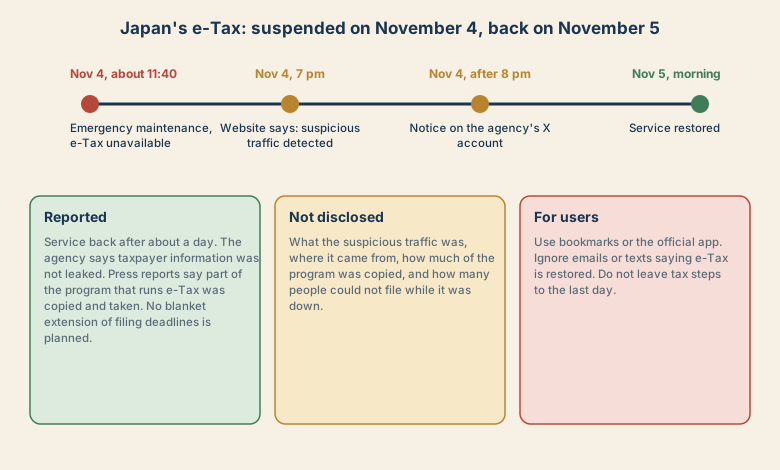
- November 4, about 11:40: e-Tax went into emergency maintenance and became unavailable.
- November 4, about 7 pm: the agency's website said the cause was suspicious traffic.
- November 4, after 8 pm: the agency posted a notice on its X account. Some users complained that this was too late.
- November 5, morning: service was restored. Reports differ slightly on the time, from about 10:30 to 11:00.
What was and was not leaked
According to the National Tax Agency, as reported:
- Taxpayer information was not leaked.
- Sensitive system information was not leaked.
- Part of the program that runs e-Tax was copied and taken outside, according to Jiji Press, which reported an agency official's remarks.
- A blanket extension of filing deadlines is not planned.
An agency official was quoted as saying that despite layered security measures, the leak of part of the program was regrettable.
What is not known
The agency has not said, or reports do not say:
- What the suspicious traffic was, and where it came from.
- Which parts of the program were copied, and how much.
- How many people were unable to complete filings or payments during the outage.
- What follow-up measures the agency will take.
Treat claims beyond these as speculation until the agency says more.
Why the program leak still matters
A copied program does not mean taxpayer data was taken, and the agency says it was not. But the program's code shows how the system is built. For a service that handles tax filings for millions of people, an attacker who studies that code may look for weaknesses to use later. That is why the follow-up fixes, and any further notices, matter.
Why the outage mattered to users
The timing was bad: Japanese media reported complaints from people trying to handle year-end tax tasks. For employees and employers, November involves year-end adjustment preparation. For companies, the tenth of the month is when withholding tax for the previous month is normally due, and many pay electronically. When a government system goes dark, people with deadlines feel it first.
What users should do
- Use a bookmark you made yourself, or the official app, to reach e-Tax. Do not use links in messages or search advertisements.
- Ignore messages saying e-Tax is restored, that your account needs confirmation, or that you must log in again. Impersonation of tax authorities is common, and incidents like this attract copycats.
- Keep proof of what you filed or paid, such as the receipt screen or the notification.
- Do not leave tax steps to the last day. Systems can fail at the worst moment.
- Use a unique password for the system, and keep your My Number card and PIN safe.
- If you were unable to file or pay on time, check the agency's notice and ask your tax office what applies. Do not assume an extension.
For foreign residents, the agency provides some English guidance, and a local tax office can answer questions. Be wary of third-party sites that offer to file for you.
Part of a wider pattern
The e-Tax incident arrived in the same week as several other reported breaches in Japan. See Japan's autumn 2026 data breach wave for the wider picture and what residents and visitors can do. Messages in Japanese pretending to be from authorities and delivery companies are covered in fake delivery texts in Japan.
Sources
- Jiji Press: e-Tax operation resumes; part of program leaked (Japanese)
- ITmedia NEWS: e-Tax resumes; safety confirmed, no taxpayer information leaked (Japanese)
- Impress Watch: e-Tax emergency maintenance, suspicious traffic detected (Japanese)
- BigGo Finance: Japan's National Tax Agency halts e-Tax over suspicious traffic
Reported as of November 8, 2026. Details may change. Check the National Tax Agency's e-Tax notices.