If your website shows Google ads, a visitor from Berlin, Paris, or London triggers different rules than a visitor from Tokyo. Google's EU User Consent Policy covers users in the European Economic Area (EEA), the UK, and Switzerland, and it applies based on where the visitor is, not where you are.
What Google requires
Publishers using Google AdSense, Ad Manager, or AdMob must use a Google-certified consent management platform (CMP) that integrates with the IAB Europe Transparency and Consent Framework (TCF) when serving ads to those users.
- EEA and UK: required since 16 January 2024.
- Switzerland: required since 31 July 2024.
Publishers' summaries and Google's help pages describe the consequence: without a certified CMP, personalized ad serving to those users is restricted, and Google notes that using alternatives may lower EEA and UK revenue.
How it works
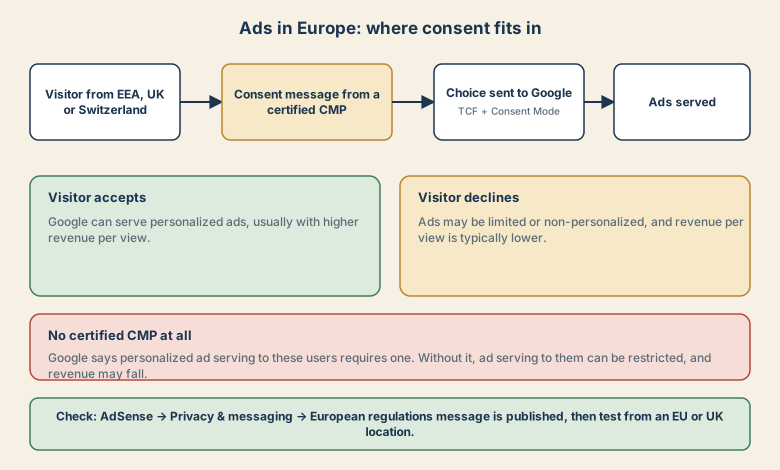
- A visitor from a covered region arrives.
- The CMP shows a consent message before ad and analytics tags run.
- Their choice is passed to Google using TCF and Consent Mode signals.
- Google serves personalized ads if they accept. If they decline, ads may be limited or non-personalized, and earn less.
Why it matters even for a "Japan-first" site
A site written in Japanese can still get European visitors, especially once it has English pages. In a small ad account, a UK or German visitor can earn several times more per view than a domestic one, so the settings that protect that revenue are worth five minutes.
A five-minute check
- Sign in to AdSense and open the Privacy & messaging area (menu names can change).
- Look for the European regulations message (GDPR message). Create one if there is none, and make sure it is published, and that your site is selected.
- Google's own consent tool is one option that meets the certification requirement. You can also use a third-party CMP that appears on Google's certified list.
- Test from a European location. Use a VPN set to Germany or the UK, open an incognito window, and check that a consent message appears before ads.
- Check other tags. If you use analytics or other third-party scripts, they should respect the visitor's choice too.
- Update your privacy policy to describe the ads and the choices people have.
Common mistakes
- Adding a generic cookie notice without a certified CMP.
- Publishing the message in the AdSense account but selecting no sites.
- Testing only from your own country and never seeing the banner.
- Forgetting that third-party scripts (analytics, embeds) may set cookies before consent.
Sources
- Google AdSense Help: consent management requirements for serving ads in the EEA, UK and Switzerland
- Google AdSense Help: EU User Consent Policy and certified CMPs
Policy summary as of November 5, 2026. Google may update its requirements; check the help pages. This is not legal advice.