Two parts of the EU Data Act (Regulation 2023/2854) affect ordinary users and small teams far more than most EU rules: your rights to data from connected devices, and the end of switching charges for cloud services. One has just started, and the other arrives in a few weeks.
The timeline
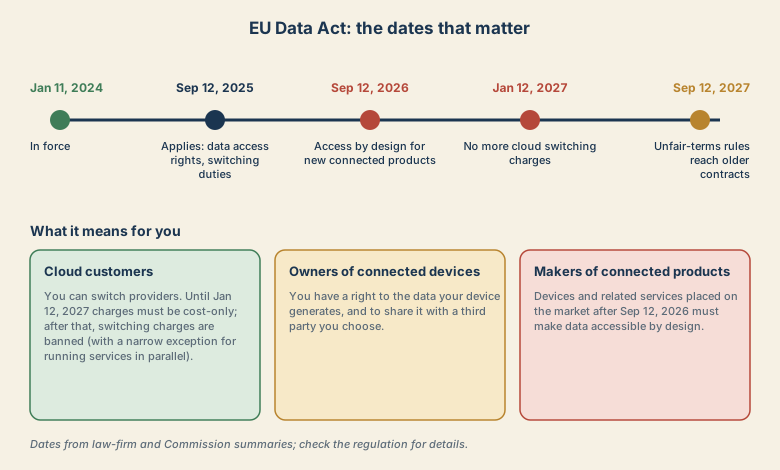
- 11 January 2024: the Act entered into force.
- 12 September 2025: it started to apply, including users' rights to access data and the duties on cloud providers to remove obstacles to switching.
- 12 September 2026: "access by design" applies to connected products and related services placed on the market from that date.
- 12 January 2027: cloud providers may no longer charge switching charges.
- 12 September 2027: the unfair-contract-terms rules reach certain older contracts.
If you buy or use cloud services
The Act makes it contractually and technically easier to leave a provider. Providers must remove barriers to switching, support exporting your data and digital assets, and offer an exit process. From 12 September 2025 until 12 January 2027, any charge for switching has to be limited to the provider's direct costs. After 12 January 2027, switching charges are banned. Summaries note an exception for customers who run services in parallel, which can still incur ongoing data-transfer costs.
What to do:
- Read your contract's exit terms. How long is the notice, and what formats can you export?
- Ask your provider how it implements the Data Act: switching process, timelines, and charges.
- Write an exit plan. Where does your data live? How would you move it, and how long would it take?
- Avoid deep lock-in. Prefer open formats and standard APIs where you can.
If you own connected devices
Since September 2025, users of connected products have a right to access the data those products generate, and to ask for it to be shared with a third party. From September 2026, newly placed products must make it easy to get at that data. Look for an export option or a request process in the manufacturer's documentation, and for what data and formats are offered. Be careful about who you share it with: the Act gives you the choice, and you carry the responsibility.
If you make connected products or related services
The design duty is now live for new products. Make it part of your release criteria:
- List the data your product generates, in what format and how often.
- Provide direct access where relevant (an interface, export, or dashboard) and clear pre-contract information.
- Plan sharing with third parties at the user's request, and protect trade secrets and security.
- Document it. Keep evidence that the feature exists and works.
Why it matters for small teams
Lock-in is expensive for small companies. The January 2027 date removes a direct cost from changing provider and gives you leverage in renewals. And the data-access rights mean your device data can power your own tools, if you ask for it.
Sources
- Regulation (EU) 2023/2854 (Data Act) on EUR-Lex
- McCann FitzGerald: Data Act developments, 2026 and beyond
- Mondaq: The Data Act, access by design requirement comes into force
Overview as of November 5, 2026. This is not legal advice.