Keeping software updated is the standard advice. Last Monday, that advice briefly worked against some server owners. The maker of cPGuard, a security suite for Linux web-hosting servers, said an unidentified attacker used compromised credentials to get into its update distribution infrastructure on November 2, 2026, around 02:06 UTC, and used that access to distribute a malicious script to customers through the normal update channel.
How the attack worked
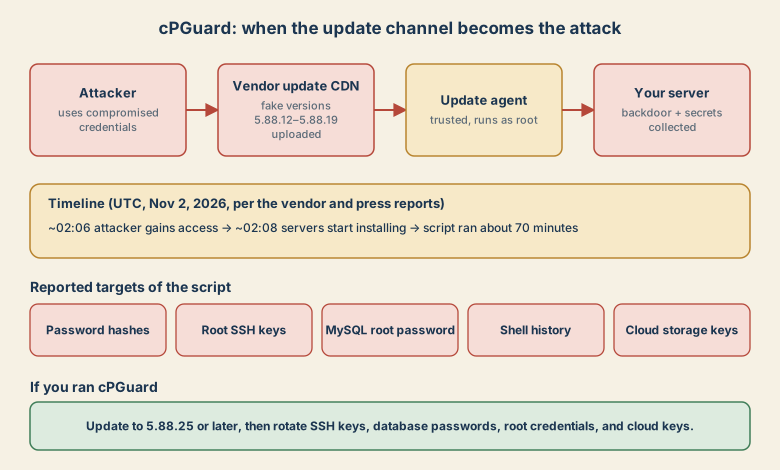
- Fake updates, reported as versions 5.88.12 through 5.88.19, were uploaded to the vendor's update storage within a few minutes.
- Customer servers whose update agents checked in during the window installed it, and the script ran with root privileges.
- According to press reports, it ran for about 70 minutes and affected roughly 2,950 to 3,000 servers.
This is a supply-chain attack: instead of breaking into thousands of servers one by one, the attacker compromised the one thing all of them trust. The update agent had permission to run code as root, because that is what it needs to do its job. The attacker inherited that permission.
What was collected
OPSSHIELD and press reports say the script installed a backdoor and collected sensitive files, including password hashes, root SSH keys, the MySQL root password where present, root shell history (which can contain typed passwords and tokens), and cloud storage keys.
Password hashes are one-way, as the vendor notes, so they cannot ordinarily be typed in to log in. But simple or common passwords can be recovered by testing guess lists offline.
If you run cPGuard
- Update to version 5.88.25 or later. The vendor says it includes a corrective update that removes the known backdoor and staged files.
- Rotate secrets. Treat these as exposed: root and user passwords, SSH keys, MySQL/MariaDB credentials, and any cloud storage keys on the server.
- Review update logs for the affected versions and the time window.
- Check outbound connections. Look for unusual traffic from the server around and after November 2.
- Follow the vendor's advisory for indicators of compromise, and watch for a separate update that removes support access keys it mentioned.
If you do not
The lesson is about trust in the update path:
- Least privilege. Give tools only the access they need.
- Egress controls. Even "trusted" vendors should not be able to send data anywhere from a production server unnoticed.
- Staged rollouts. Update a test server first where possible.
- Verify what you can. Prefer vendors that sign updates and publish checksums, and that protect their own distribution with strong credentials and multi-factor authentication.
The vendor said it was still investigating how the credentials were obtained.
Sources
- cPGuard security advisory: Update channel compromise (OPSSHIELD)
- Poisoned cPGuard update hits thousands of web hosting servers (Help Net Security)
- cPGuard Update Channel Hijacked to Backdoor Linux Servers (The Hacker News)
Reported as of November 5, 2026. Check the vendor's advisory for current guidance.