Two things trigger this problem. One is an error such as UnicodeEncodeError: 'shift_jis' codec can't encode character '\uff5e'. The other is text that silently turns into ? after a round trip through a Windows system. Both come from treating Shift_JIS and CP932 as the same thing.
They are close, not identical
Shift_JIS is the JIS-standard encoding. CP932, also called Windows-31J, is Microsoft's variant: it keeps the same byte layout but maps a few bytes to different characters and adds extra ones. Windows software uses CP932 even when its menus say "Shift_JIS".
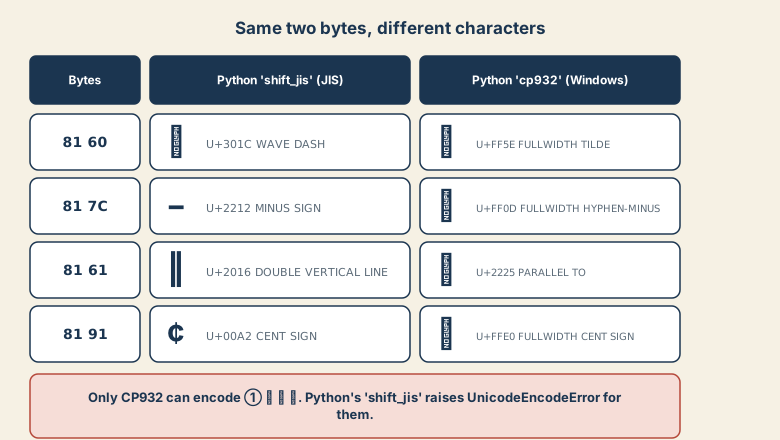
The famous case is the wave dash. Bytes 81 60 are 〜 (U+301C) in Python's shift_jis codec and ~ (U+FF5E, fullwidth tilde) in cp932. They look nearly the same, but they are different characters. So encoding ~ with shift_jis fails, and a 〜 read from a standards-based system may show up as ? or a different glyph on Windows.
You can see it yourself:
b = bytes([0x81, 0x60])
print(hex(ord(b.decode("shift_jis"))))   # 0x301c  〜
print(hex(ord(b.decode("cp932"))))       # 0xff5e  ~

"~".encode("cp932")      # works
"~".encode("shift_jis")  # UnicodeEncodeError
What else differs
| Bytes | shift_jis | cp932 |
|---|---|---|
| 81 7C | − (U+2212 minus) | - (U+FF0D fullwidth hyphen-minus) |
| 81 61 | ‖ (U+2016) | ∥ (U+2225) |
| 81 91 | ¢ (U+00A2) | ¢ (U+FFE0) |
CP932 also contains characters that strict Shift_JIS lacks, including circled numbers ①, the company symbol ㈱, and the variant kanji 髙 and 﨑 that appear in real people's names. Encoding these with shift_jis raises UnicodeEncodeError.
Which codec should you use?
- Reading or writing files for Windows or Excel:
cp932. - Interoperating with a system documented as strict JIS:
shift_jis, but expect failures on the characters above. - Anything you control end to end: UTF-8.
Fixing the error on write
If you hit the error and the destination expects Shift_JIS-style data, switch to cp932 first. If you really need strict shift_jis, convert the problem characters beforehand:
FIX = str.maketrans({
    "\uff5e": "\u301c",   # ~ -> 〜
    "\uff0d": "\u2212",   # - -> −
    "\u2225": "\u2016",   # ∥ -> ‖
    "\uffe0": "\u00a2",   # ¢ -> ¢
})

text = text.translate(FIX)
data = text.encode("shift_jis")
Characters with no equivalent (such as ①) still fail. Decide per case: replace them (errors="replace"), expand them (① → 1), or stop and use UTF-8.
Avoiding silent damage
The worst case is not an error but a quiet ?. To catch it, round-trip a sample: encode, decode, and compare with the original. If they differ, your chosen encoding loses data.
Quick checklist
- Windows produced the file? Read it as
cp932. - Error on
~,①,㈱? That is the CP932-only set. - Strict JIS target? Map the wave dash and friends before encoding.
- You control both ends? Use UTF-8 and skip the whole problem.