You turned on multi-factor authentication for your VPN, and you may still not be protected. A flaw in SonicWall's SonicOS SSLVPN, tracked as CVE-2026-19868, lets a user who has valid credentials for an alternate login method skip SAML and the multi-factor step enforced through it. On November 6, 2026, CISA added it to its Known Exploited Vulnerabilities catalog, with a remediation deadline of November 20 for US federal agencies.
What the flaw does
SAML is how a firewall hands the sign-in to your identity provider, such as Microsoft Entra ID, so that your multi-factor rules apply. The flaw is that the SSLVPN service does not properly enforce that path. A user with valid credentials for another authentication method that is still enabled, such as a local account or a directory login, can log in without going through SAML, and so without the second factor.
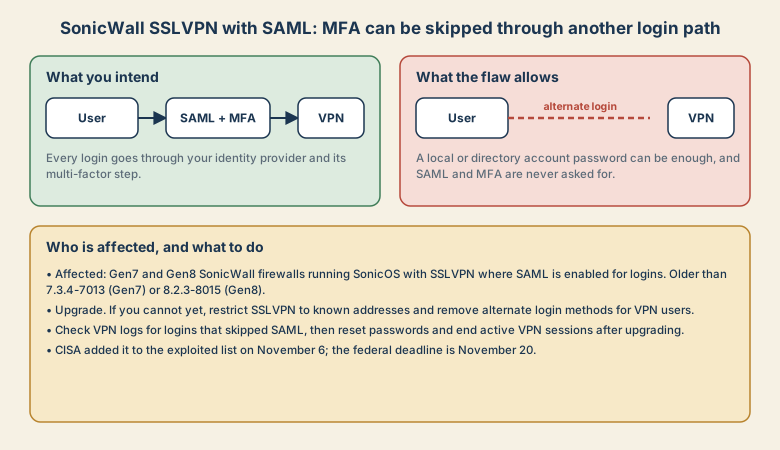
The flaw affects the SSLVPN service only when SAML is enabled for SSLVPN logins. Security vendors summarising the bulletin give a severity score of 7.1 (high) from the vendor and 7.5 from CISA. It does not let a stranger in without any credentials, but if an attacker holds a stolen or reused password, the multi-factor protection you counted on does not apply.
Who is affected, and the fixed versions
According to the vendor bulletin SNWLID-2026-0014 as summarised by security vendors:
- Gen7 firewalls: affected up to 7.3.3-7015, fixed in 7.3.4-7013 or later.
- Gen8 firewalls: affected up to 8.2.2-8015, fixed in 8.2.3-8015 or later.
The vendor lists no workaround, so the update is the fix. The same update also closes other vulnerabilities, including management-interface flaws rated 8.8 and a pre-authentication buffer overflow in SSL-VPN that can crash the service. Firewalls that do not use SAML on SSLVPN are not vulnerable to this particular flaw but should still be updated.
What to do
- Check your firmware version and your SSLVPN login method. Do you use SAML for VPN logins?
- Upgrade to the fixed version for your hardware generation.
- If you cannot upgrade today, consider temporarily limiting internet-facing SSLVPN to known source addresses, and remove alternate login methods for VPN users that you do not need.
- Look for signs of misuse: review SSLVPN logs for logins that did not pass through the SAML provider, logins from unusual addresses or countries, and sign-ins by accounts that should only use SAML.
- After upgrading, reset passwords for accounts that have alternate login methods and end active VPN sessions.
Because the flaw is exploited, assume that credentials which could have been used in this way may already be known to an attacker, and treat unexplained logins seriously.
The lesson: the weakest path sets the strength
This bug is a clear example of a general rule. Multi-factor authentication protects the door you put it on, not the building. If an older login path stays enabled, an attacker with a password can use it. In practice:
- Disable legacy and alternate login methods for remote access when single sign-on is in place.
- Keep one enforced path into the VPN, and document it.
- Log and review the login method, not just success or failure.
- Treat remote-access appliances as high-priority patching, since they face the internet.
- Use phishing-resistant methods where possible, such as passkeys or security keys, since a second factor that is a push approval can itself be attacked.
Quick checklist
- Do you run SonicWall Gen7 or Gen8 with SAML on SSLVPN?
- Upgrade to 7.3.4-7013 or 8.2.3-8015 or later.
- Restrict SSLVPN access and remove unneeded alternate logins until you can.
- Review VPN logs for logins that skipped SAML.
- Reset passwords and end sessions after upgrading.
Sources
- SonicWall PSIRT: SNWLID-2026-0014, SonicOS affected by multiple vulnerabilities
- CISA: Known Exploited Vulnerabilities Catalog
- NVD: CVE-2026-19868
- nFlo: CVE-2026-19868 summary
Reported as of November 7, 2026. Check the vendor bulletin for current guidance and exact firmware versions for your model.
Related: WordPress core updater flaw and account hacked.